How-to
How to play Stack 21
Four lanes, one deck, and a decision with every card. Learn the rules, walk through a hand, and leave yourself room for the next deal.
By ClickClick · · 3 min read
Start with four empty lanes
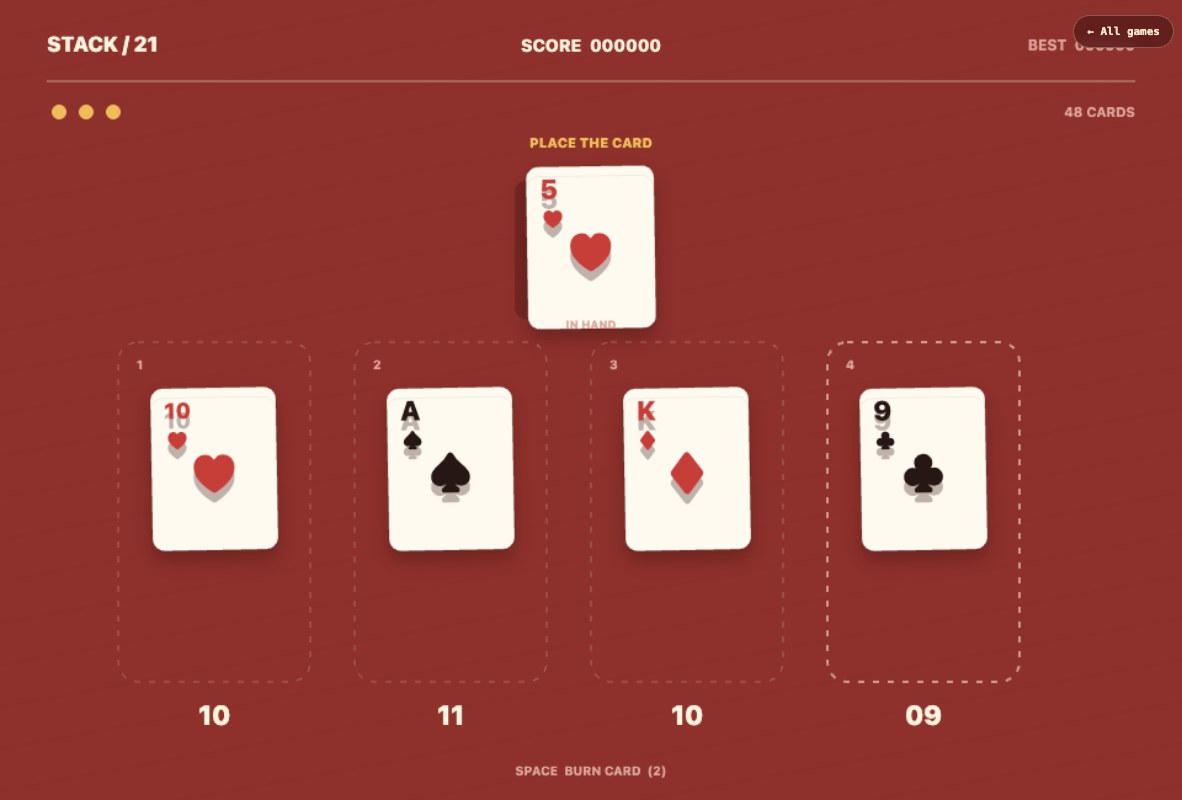
Stack 21 is a solo card game about making space. You receive one card at a time and place it into one of four lanes. A lane clears when its cards total exactly 21. Go over 21 and that lane busts: its cards disappear, you lose a life, and your scoring combo resets. You start with three lives and two burns.
Number cards are worth their printed value. Jacks, queens, and kings are worth 10. An ace counts as 11 unless that would push the lane over 21, in which case it counts as 1. Suits do not change a card's value. There is also a five-card clear when a lane reaches five cards without busting, so small cards can create space without making exactly 21.
Place a card or burn it
Select a lane with your pointer, or press 1, 2, 3, or 4 on your keyboard. Press Space or use the burn control to discard the current card. A burn skips that card; it does not empty a lane. A burn also resets your combo. With only two burns for the deck, treating them as an emergency exit gives you more choices later.
- Read the current card and all four lane totals.
- Look for an exact 21 before opening a new lane.
- If no clear is available, choose a placement that keeps different totals on the table.
- Burn only after checking every lane, including any ace that can change value.
Work through one decision
Imagine your lanes total 11, 16, 8, and 0. The current card is a king, worth 10. Put it on 11: that lane reaches 21 and clears immediately. Putting it on 16 would bust, and putting it on 8 would leave a crowded 18 while passing up a clear.
Now imagine the next card is a 5. Adding it to 16 clears another lane. The lesson is to read the whole table before placing a card. A high total is useful when it has a clear partner; several lanes needing the same small card are harder to manage.
Keep different ways out
An empty lane can accept any single card. Spending that flexibility too early can leave all four lanes waiting for narrow answers. Before filling an empty lane, check whether the current card has a safe home elsewhere. This is a useful habit, not a rule that overrides an immediate clear.
Exact-21 clears grow your combo and award 210 points multiplied by the current combo. Busting breaks it. Chase clears while looking at the cost: a promising score is less useful if the remaining lanes cannot accept the next card. Your first goal can simply be getting through more of the deck with fewer busts.
Give your next run one small goal
For a first run, say each lane's total before placing a card. For the next, notice how often you spend a burn while a safe placement still exists. You do not need to memorize the deck to improve; making the decision visible is a good place to start. Stack 21 saves an active run in this browser where local storage is available, so you can return to an unfinished table on the same device.
Updated